
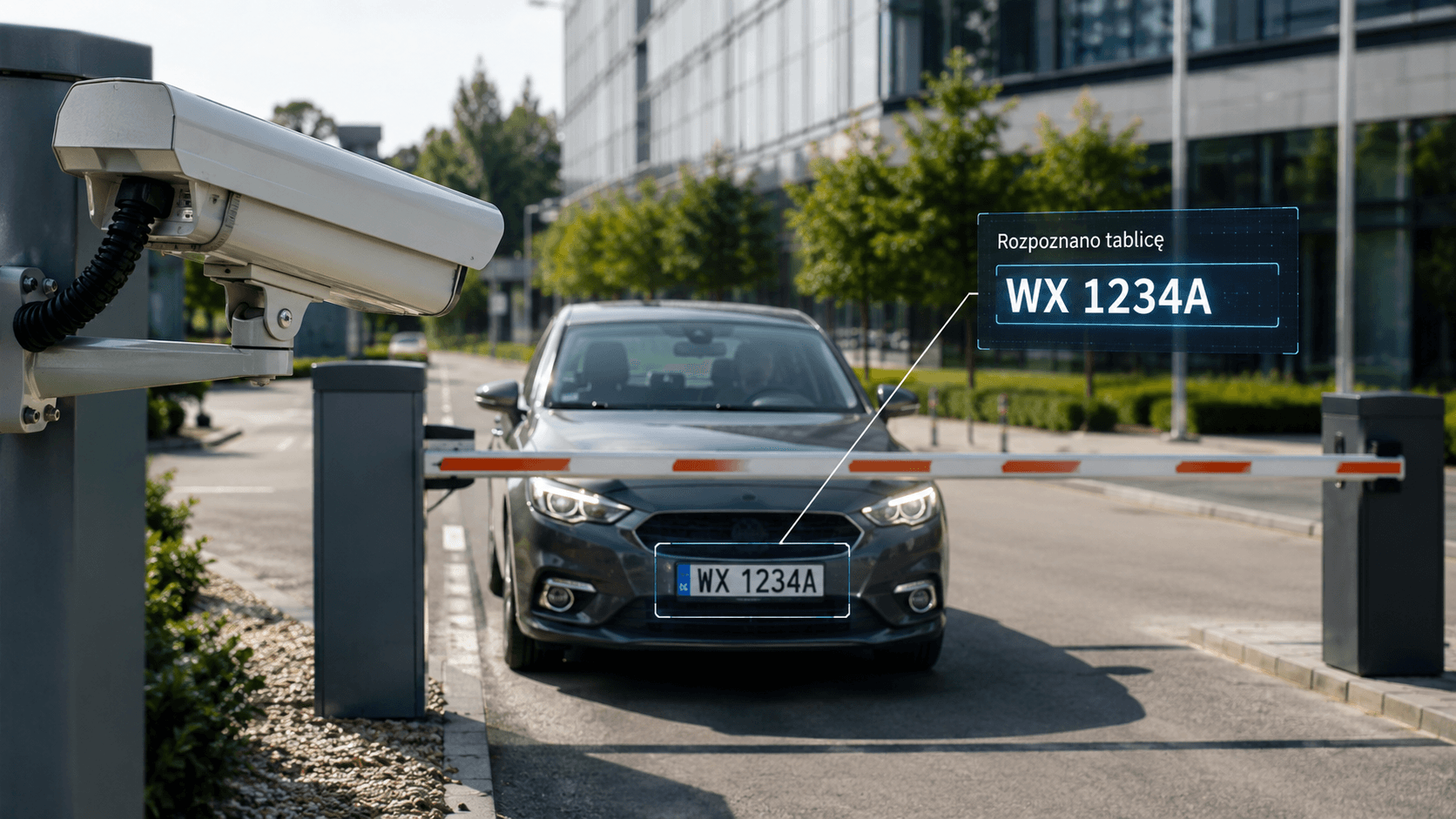
Imagine a car park where, every morning, a queue of twenty vehicles forms at the entrance. Drivers search for cards, a guard checks lists, the barrier rises and falls - and the minutes disappear. Over the course of a year, that adds up to hundreds of hours lost and thousands of zlotys in avoidable costs.
According to industry data, companies that rely on manual vehicle access control can lose the equivalent of as many as five full-time roles each year to gate operations and vehicle records alone. On top of that come human error, incomplete documentation and user frustration.
The answer is an automatic licence plate recognition system powered by artificial intelligence. In this article, we explain how this technology works, what benefits it delivers and why more and more companies in Poland are choosing to implement it.
What is a licence plate recognition system?
A licence plate recognition system is a technology that automatically reads vehicle registration numbers using a camera and AI-driven software. It operates in real time - from the moment a car enters the camera's field of view to the moment the barrier opens, only a fraction of a second passes.
You can think of it as a receptionist who knows every authorised vehicle by heart, never makes mistakes and works 24 hours a day, 365 days a year - without coffee breaks.
Two abbreviations are used interchangeably across the industry:
- LPR (License Plate Recognition) - licence plate recognition
- ANPR (Automatic Number Plate Recognition) - automatic licence plate recognition
Both terms refer to exactly the same thing. A key part of the system is OCR (Optical Character Recognition), which is responsible for 'reading' the letters and digits captured in the image.
Licence plate recognition vs traditional vehicle access control methods
Before we look at how the system works, it is worth understanding how automatic licence plate recognition compares with more traditional approaches to vehicle access control. Each method has its strengths, but ANPR offers a set of advantages that are difficult to match in other ways.
Remote controls and proximity cards
Gate remotes and RFID cards are still the most common solutions in Polish housing estates and car parks. They are simple to use, but they come with significant drawbacks - they can be lost, stolen or copied. Replacing a lost remote costs between PLN 80 and PLN 200, and a security incident can force a full system replacement for every user. A licence plate recognition system eliminates that problem entirely, because the registration plate is always with the vehicle.
Gatehouse attendant or security guard
Manual gate control offers flexibility, but it creates ongoing payroll costs and remains vulnerable to human error. A guard may fail to recognise a vehicle, let an unauthorised car through or simply be unable to keep up during peak hours. An ANPR system works with the same level of precision regardless of the time of day, traffic intensity or weather conditions.
Ticket machines and parking systems
Traditional ticket-based systems require expensive infrastructure - ticket machines, barriers and thermal printers. Every device needs servicing and every device can fail. A system based on licence plate recognition needs only a camera and a computer - a significantly simpler and more cost-effective setup to maintain.
Why does ANPR come out ahead?
The decisive advantage of licence plate recognition over traditional methods is the absence of physical access media. Drivers do not need to carry a card, remember a code or wait for a security guard. The system identifies the vehicle automatically and accurately. At the same time - unlike RFID systems - it does not require tags to be installed in every vehicle, which lowers implementation costs and simplifies the management of authorised fleets.
How does the system work step by step?
The entire licence plate recognition process takes less time than a blink. Here is what happens behind the scenes when a vehicle approaches the gate:
Step 1: The camera captures the image
The surveillance camera - a standard IP camera rather than specialist equipment costing tens of thousands - captures the approaching vehicle. The system analyses the video stream in real time, processing dozens of frames per second.
Step 2: Artificial intelligence detects the vehicle
The first AI model scans the image and identifies the vehicle. In practice, that means the system first 'understands' that there is a car in the frame before it starts searching for the plate itself. This makes it more accurate than solutions that try to detect the plate directly across the entire image.
Step 3: The system locates the registration plate
The second AI model, trained specifically for plate recognition, analyses the vehicle area and pinpoints the exact position of the registration plate. This two-stage approach significantly improves accuracy - the system does not confuse the plate with other vehicle elements such as stickers or advertising text.
Step 4: The registration number is read
The cropped image of the plate is passed to the OCR module, which recognises individual letters and digits. The system is optimised for Polish registration plates - it understands their format, knows Polish regional codes and can correct common reading errors, such as confusing the letter 'O' with the digit '0'.
Step 5: Verification and decision
The detected registration number is instantly compared against a database of authorised vehicles. If the vehicle has permission, the barrier opens automatically. If it does not, the event is logged and security staff can take the appropriate action.
Step 6: Event logging
Every entry and exit is recorded by the system - date, time, registration number and access decision. That means a complete, automatic audit trail that is available whenever it is needed.
What sets our solution apart?
There are many licence plate recognition systems on the market. The solution developed by Type Of Code stands out because of several key elements that translate directly into higher accuracy and greater day-to-day reliability.
Two-stage AI detection
Most competing solutions use a single AI model to find plates directly in the camera image. Our solution uses a two-stage approach - first it detects the vehicle, and only then does it search for the plate within the boundaries of that vehicle.
It is the difference between searching for a word on an entire newspaper page and searching for it within a single paragraph - the second approach is both faster and more accurate.
Optimised for Polish registration plates
This is not a generic tool designed to be 'good enough' for everything. It was built specifically for the Polish market - it understands Polish plate formats, recognises regional codes and applies intelligent corrections that fit the Polish registration system.
For example, when the system reads 'SCZ976O3' instead of 'SCZ97603', it can automatically correct the result, recognising that the 'O' in the numeric section is most likely a zero.
Industrial-grade barrier integration
Instead of amateur solutions built around consumer-grade controllers, our system communicates with professional industrial devices such as the MOXA ioLogik E1212. This is the same class of hardware used in industrial automation and critical infrastructure.
What does that mean in practice? Reliability at the level required by facilities that operate 24/7 - without freezes, without communication failures and with automatic command retries whenever connectivity is temporarily lost.
One solution for any hardware
The system automatically detects the available hardware and adjusts its parameters to ensure optimal performance. Whether it runs on a workstation with a graphics card, an industrial server or a Mac - it selects the best settings on its own.
That removes the need for manual tuning for each hardware setup and makes deployment across different locations much easier.
Safe deployment with test mode
Before the system is launched live with real cameras and barriers, it can be tested on recorded video footage. Test mode makes it possible to verify plate recognition accuracy, fine-tune settings and train staff - all without disrupting day-to-day operations.
Once testing is complete, switching to production mode requires only a single configuration change.
Where does this type of system work best?
Automatic licence plate recognition is a technology with broad practical application. It works wherever vehicle movement needs to be controlled - from smaller residential developments to large logistics hubs.
Residential developments and housing communities
Across Polish housing estates, the problem of unauthorised vehicles continues to grow. A licence plate recognition system allows residents to enter automatically, guests to be recorded and unauthorised vehicles to be blocked from access. No more lost gate remotes and no more costly full-system replacement because one device ended up in the wrong hands.
Office buildings and business centres
In office environments, time and convenience matter. Automatic entry without cards or tickets offers the same level of comfort people expect from automatic doors - once a vehicle is registered, it is recognised every time. Building managers retain full visibility into who uses the car park and when.
Commercial car parks
In large public car parks, ANPR removes the need for tickets and cash-based service. Vehicles are identified on entry and exit, and settlement can happen automatically. That means savings on infrastructure such as ticket machines and barriers, as well as on staffing.
Logistics centres and warehouses
In logistics, accurate vehicle records are essential to both security and efficiency. The system automatically logs every transport - when it arrived, how long it stayed on site and when it left. Reports are generated in real time, without manual data entry.
Industrial facilities
Factories, refineries and power plants - anywhere security depends on precise control over vehicle movement - LPR serves as a strong first line of defence. Integration with industrial controllers ensures reliability even in the most demanding operating conditions.
Hotels and hospitality venues
Hotel guests value convenience and freedom from unnecessary formalities. A licence plate recognition system can automatically open the parking barrier for a guest whose vehicle has already been registered during the booking process. No parking cards, no queues at reception - the car approaches and the barrier lifts. It is a modern service element that shapes positive guest experiences and repeat business.
EV charging stations
As electric vehicles become more common in Poland, charging stations are becoming an increasingly important part of parking infrastructure. ANPR can identify vehicles authorised to use charging stations and automatically reserve designated spaces for them, while preventing combustion-engine vehicles from occupying charging bays.
What benefits does automated entry control deliver?
Automating entry control with licence plate recognition brings measurable financial and operational benefits. It is not only a matter of convenience - it is a real saving in time and money, combined with stronger security.
Time and cost savings
Implementations of automated gate control in Polish companies show that it is possible to free up the equivalent of as many as five full-time roles per year - staff who previously handled manual barrier operations and vehicle records. That translates into direct savings of hundreds of thousands of zlotys annually.
At the same time, traffic throughput increases - instead of spending 30 to 60 seconds on manual verification, the system reads the plate and opens the barrier in less than a second.
Full audit trail and security
Every event - entry, exit or denied access - is automatically saved in the database with an exact date and time. That eliminates the problem of incomplete documentation and provides a full picture of vehicle traffic on site.
If a security incident occurs, the administrator has immediate access to the full history of vehicle movements - without having to review hours of camera footage.
User convenience
From the driver's perspective, the experience is simple: you arrive and the barrier opens. No cards, remotes, tickets, codes or mobile apps. The system identifies the vehicle by its registration plate and the entire process remains invisible and effortless.
That is particularly important in high-traffic facilities, where even a few seconds saved on each entry eliminate queues during peak periods.
Easy permission management
Adding a new vehicle to the system is as simple as entering its registration number into the database - no card programming, remote configuration or physical badge issuance required. Revoking access is just as straightforward.
Each vehicle can also be assigned a specific access level, such as employee, guest or supplier, along with an authorisation period. Once that period expires, the system automatically blocks access.
Real-time reporting
The system generates detailed reports covering traffic statistics, peak entry hours, average time spent on site and many other metrics. This data helps optimise parking management and supports smarter operational planning.
Faster ROI than you might expect
In most cases, a licence plate recognition system pays for itself within 12 to 18 months. The main sources of savings are reduced labour costs for gate handling, elimination of spending on cards and remotes, lower maintenance costs for ticketing infrastructure and fewer losses caused by unauthorised entries.
For a site with three entry barriers and around 500 vehicles per day, annual operational savings can reach hundreds of thousands of zlotys once staff time, consumables and opportunity costs are taken into account.
Why is 2026 the right time to deploy ANPR?
The year 2026 is an especially strong moment to invest in automated vehicle access control. Several converging trends have made licence plate recognition more accessible and more commercially viable than ever before.
Artificial intelligence has matured
AI models used to recognise objects in images have reached a level of accuracy that, not long ago, was reserved for military-grade systems. Thanks to advances in machine learning, modern ANPR systems are more precise, faster and able to run on cheaper hardware than systems available only two or three years ago.
IP cameras are cheaper than ever
The price of IP cameras with resolution sufficient for licence plate recognition - Full HD and above - has dropped by more than 40% in recent years. A camera that would have cost PLN 2,000 a few years ago is now typically available for PLN 800 to PLN 1,200. That significantly lowers the entry barrier for organisations considering an ANPR deployment.
GDPR requirements encourage automation
Paradoxically, stricter personal data protection requirements favour automated systems. Manual vehicle records kept in notebooks, spreadsheets or unsecured databases are difficult to reconcile with GDPR obligations. An automated system with controlled access, an encrypted database and a clear data retention policy is much easier to align with legal requirements.
Poland's infrastructure continues to expand
New housing estates, logistics centres and business parks are being developed across Poland, creating demand for modern access-control systems. Investors increasingly treat automatic licence plate recognition as a standard rather than a premium extra - much like video surveillance became the norm a decade ago.
Security and reliability of the system
Reliability is the foundation of every access-control system. The licence plate recognition solution developed by Type Of Code was designed for continuous, unattended operation in real production environments.
Automatic command retries
Communication between the system and the barrier controller takes place over the network. If a single signal fails to reach the barrier because of a temporary connection issue, the system retries automatically - with increasing delays so as not to overload the network. The operator does not need to intervene; the system handles brief failures on its own.
Intelligent cache
The system stores information about recently checked vehicles in a fast local cache. That means frequently arriving vehicles - for example, those entering every morning - can be verified almost instantly, without querying the database every time. The cache is refreshed automatically to ensure it always reflects the current state of permissions.
Full event log
Every system event - from plate recognition, through the access decision, to sending the signal to the barrier - is recorded in a structured event log. Logs are grouped by category, such as system, access, recognition and barrier communication, and archived automatically, which makes diagnostics and audit easier.
Manual emergency override
For exceptional cases - for example, when an ambulance without a registered plate needs to be admitted immediately - an operator can open the barrier manually with a single command. The system records that action as a manual opening, preserving a complete history.
Device health monitoring
The system regularly checks communication with the barrier controller and reports reliability metrics such as successful connection rate, average response time and failure history. Administrators receive clear, actionable statistics without having to analyse raw technical logs.
Frequently asked questions
How much does it cost to implement a licence plate recognition system?
The cost depends on the scale of the site and the required functionality. A basic system for a single entry point starts at several tens of thousands of zlotys. In larger environments - with multiple gates or integration into existing infrastructure - costs are higher, but still significantly lower than maintaining manual operations over a two- or three-year horizon. We offer a free consultation during which we prepare an initial estimate tailored to your site's needs.
Does the system work at night and in bad weather?
Yes. The system works with cameras equipped with infrared illumination, making plate reading possible even in complete darkness. Rain, snow and fog can reduce image quality, but multi-variant processing - where the system analyses the plate using several methods at once - helps maintain high recognition accuracy even in challenging conditions.
How quickly does the system read plates?
The entire process - from the moment a vehicle enters the camera's field of view to the moment the barrier opens - takes less than a second. Depending on the hardware, the system processes from 15 to more than 50 frames per second, ensuring smooth operation even when vehicles move quickly.
Can I use my existing cameras?
In many cases, yes. The system works with standard IP cameras provided that they offer sufficient resolution. It does not require specialist ANPR cameras, which can cost anywhere from PLN 8,000 to PLN 15,000 per unit. During the consultation, we assess whether your current camera infrastructure is sufficient.
Is the system GDPR-compliant?
The system was designed with personal data protection requirements in mind. Registration numbers are processed locally - on a server located on the site - without sending data to the cloud. Data is stored only for as long as there is a legitimate purpose for doing so, such as access control or record-keeping, and access is protected by authorisation.
What does the implementation process look like?
Implementation runs in four stages:
- Consultation - analysis of the site's needs, assessment of the existing infrastructure and an initial estimate.
- Configuration and testing - installation of the system in test mode using video recordings from the site's cameras. Recognition accuracy is verified without interfering with ongoing operations.
- Production launch - connection to live cameras and the barrier controller, followed by staff training.
- Support and optimisation - monitoring of effectiveness, parameter tuning and ongoing technical support.
A typical deployment of a basic system takes from one to two weeks.
Summary
Automatic licence plate recognition is a technology that changes the way vehicle access is managed at facilities of every scale. Instead of cards, remotes and gatekeepers, you get an intelligent camera, artificial intelligence and a barrier that opens on its own.
The system developed by Type Of Code combines:
- Two-stage AI detection - higher accuracy than single-stage solutions
- Optimisation for Polish registration plates - dedicated corrections and format validation
- Industrial-grade barrier integration - MOXA industrial devices rather than consumer-grade controllers
- Automatic performance optimisation - one solution for any hardware
- Safe deployment - test mode on recorded video before production launch
The benefits are measurable: lower staffing costs, no physical access media, full records of vehicle movements and real-time reporting. And thanks to falling IP camera prices and the growing maturity of AI, 2026 is an ideal time to invest.
Whether you manage a residential development, an office building, a logistics centre, a hotel or an industrial facility, automating vehicle access control is an investment that pays back faster than most organisations expect.
Free consultation
Want to find out how a licence plate recognition system could improve access control at your site? Book a free consultation and we will analyse your needs, assess your existing infrastructure and propose a solution aligned with your budget.
Type Of Code - AI, automation and modern web applications for business.
- Website: typeofcode.com
- Email: contact@typeofcode.com
- Location: Wroclaw, Poland | We support clients across Poland and Europe
Article published on 13 May 2026 by Type Of Code - a software studio specialising in artificial intelligence, process automation and bespoke web applications.